On 14 May 2026, five Italian divers descended into a deep cave system at Devana Kandu in Vaavu Atoll and did not return. Monica Montefalcone, a marine scientist and associate professor at the University of Genoa, her daughter Giorgia Sommacal, research fellow Muriel Oddenino, marine biologist Federico Gualtieri, and diving instructor Gianluca Benedetti were attempting to access an overhead environment whose entrance sits between 55 and 60 metres. Three days later, Sgt-Major Mohamed Mahudhee of the Maldives National Defence Force died of decompression illness while attempting to recover their bodies. The MNDF has since suspended its search, and a team of Finnish cave divers mobilised by DAN Europe has taken over the recovery mission.
The incident has drawn a wave of global attention to the Maldives for something the country has never been known for. Cave diving is not part of its identity as a dive destination, and "cave diving in the Maldives" is not a phrase that, until this month, anyone outside a small technical community associated with the country's atolls. The reality is the opposite of what the spike in search interest suggests.
There are two reasons for that. The first is geological: the Maldives has very few cave systems, and the ones that do exist are deep, technical, and almost never visited by recreational divers. The second is regulatory: Maldivian law tightly limits how deep, how long, and how decompressively a recreational diver may dive, and those limits exclude cave diving by design.
What follows is an honest guide to both of those points, to what Maldivian diving actually offers in their place, and to how to choose an operator that respects the rules as carefully as the country's regulators wrote them.
Is the Maldives a cave-diving destination?
In a word, no. The Maldives is not, and has never been, a cave-diving destination in the way that Mexico's cenotes or Florida's springs are. There are no charter operators here whose primary business is cave diving. There are no maps in dive shop reception rooms marking out cave systems for visiting divers. The country's recreational diving framework does not contemplate cave diving at all.
What the Maldives does have, at a very small number of sites, are overhead environments deep enough and complex enough to attract technical cave divers who arrive with their own equipment, their own training, and, in principle, their own permissions. Devana Kandu in Vaavu Atoll is one of those sites. Its reputation among the tiny global community of technical cave divers is well established. Its place on a standard recreational itinerary is not.
For the holidaying diver, meaning the AOW-certified guest staying at a resort or boarding a liveaboard, the relevant fact is simple: cave diving is not on the menu, and any operator that suggests otherwise is operating outside the law.
Diving rules in the Maldives: the 30-metre limit explained
The country's diving regulations are issued by the Ministry of Tourism and treated by reputable operators as black-letter rules rather than guidance. Their main provisions are tighter than many visiting divers realise:
- Open Water divers are limited to a maximum depth of 18 to 20 metres.
- Advanced Open Water divers and above are limited to a maximum depth of 30 metres.
- Decompression diving is prohibited. All dives must be conducted within no-stop limits.
- Maximum dive time is 60 minutes.
- Solo diving is prohibited. Every dive must be conducted with a buddy or guide.
Any plan to exceed these limits, whether by depth, by time, or by entering an overhead environment that requires staged decompression, falls outside recreational diving and into the technical sphere. Technical diving in the Maldives requires both the appropriate certification and explicit permission from the relevant authorities. In practice, that permission is rarely granted to visiting divers and never granted casually.
The Ministry is currently consulting on extending the maximum recreational depth to 40 metres, in line with PADI's worldwide limit. That change has not yet been adopted. Even if it is, it will not legalise cave diving on a recreational ticket.
How the May 14 dive happened
The obvious question, after a piece that explains how restricted cave diving is in the Maldives, is how five people ended up doing it. The reporting in the days since the incident gives a reasonably clear picture, and it answers the question without contradicting any of the points above.
The group was not on a sanctioned cave-diving excursion. Monica Montefalcone and Muriel Oddenino were in the Maldives on an official University of Genoa scientific mission, monitoring marine biodiversity and the effects of climate change on tropical reefs. The dive at Devana Kandu was not part of that research. The university has confirmed it was undertaken privately, outside the scope of the academic trip.
The tour operator that managed the Maldives leg of the journey, Albatros Top Boat, has stated publicly that it did not authorise or know about the dive. Its spokesperson, Orietta Stella, told reporters that the company "did not know" the group planned to descend beyond 30 metres, and that crossing that threshold requires special permission from Maldivian maritime authorities. The operator, she said, "would have never allowed it." The team's home liveaboard, the Duke of York, is the vessel from which the dive was launched.
What the team did have was experience. Montefalcone was a marine scientist with years of fieldwork, Federico Gualtieri was a marine biologist, and Gianluca Benedetti, the only body so far recovered, was a diving instructor and the Duke of York's liveaboard operations manager. Carlo Sommacal, Monica Montefalcone's husband, has publicly defended the team's experience and safety protocols.
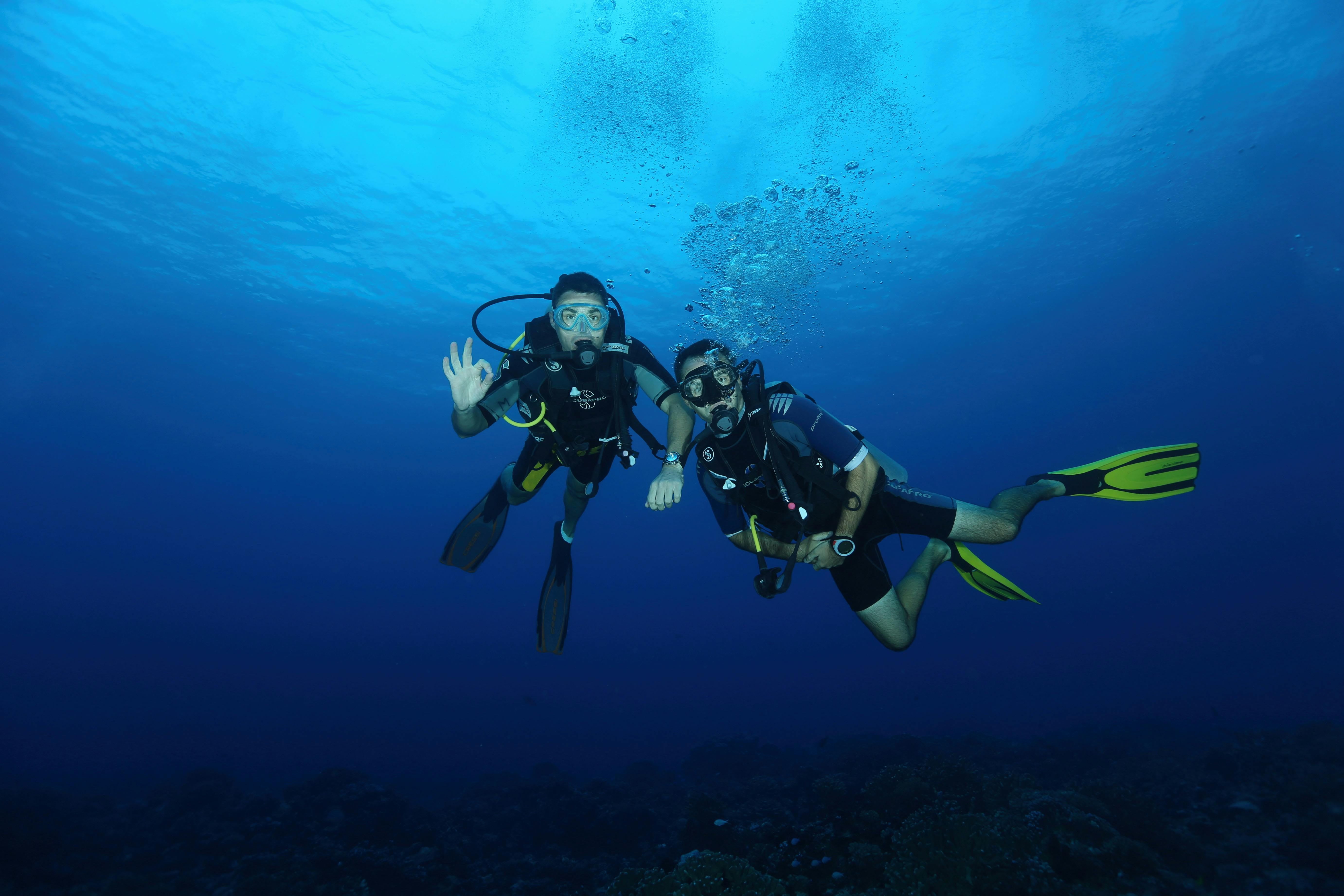
But experience is not training, and recreational training is not cave training. Early reporting indicates the team descended in standard recreational scuba equipment rather than the doubled cylinders, redundant regulators, reels, and gas-management hardware that define a cave-diving rig. A yellow weather warning had been in force that day, with rough seas and currents at the channel mouth. The dive entered an overhead environment whose access point sits between 55 and 60 metres, beyond Maldivian recreational depth limits, with no permission from the relevant authorities and no authorisation from the trip's tour operator.
In other words, the dive happened not because the Maldives is set up for cave diving, but because a small private group, including a staff member from the liveaboard itself, made an off-itinerary decision to attempt a dive that the country's rules, its operators, and its diving infrastructure are deliberately built to prevent. That is also, in a sober way, the reason the rest of this guide matters. The legal and operational limits described above exist precisely so that this kind of decision does not become a standard part of the country's diving culture.
Why the Maldives has channels, not caves
To understand the Maldives underwater, look at it from above. Twenty-six coralline atolls sit atop a submerged volcanic platform that runs north to south for almost 900 kilometres. Each atoll is a ring of reef enclosing a lagoon, broken at intervals by channels, the kandus, through which ocean water flushes in and out with the tides.
That geometry produces an extraordinary recreational dive landscape, but a thin cave-diving one. The structures divers come for here are:
- Channel drifts: fast-moving dives along channel walls, where the current concentrates pelagic life into a narrow corridor.
- Thilas and giri: pinnacle reefs that rise from the atoll floor, swarming with reef fish and patrolled by grey reef sharks.
- Overhangs and swim-throughs: short, well-lit passages cut into the reef wall, normally entered briefly during a wider dive.
- Wrecks: a small but storied set, including the Maldive Victory in North Malé and the Halaveli wreck in Ari Atoll.
True caves, meaning the long, dark, silt-floored, no-direct-ascent overhead environments that define cave diving, are vanishingly rare and almost never shallow. Where they exist, as at Devana Kandu, the access point typically sits below 50 metres. That is not a recreational dive site. That is a technical project for a fully trained, fully equipped cave team, and even then, in the Maldives, an irregular one.
What Maldives diving is actually famous for
The reason the Maldives sits near the top of almost every serious diver's list is not what is underneath the reef. It is what passes over it.
Manta rays. Hanifaru Bay in Baa Atoll is the most reliable manta aggregation site in the world. Between May and October, dozens or hundreds of reef mantas feed in a tight bay alongside whale sharks. Diving is prohibited at Hanifaru by law. The bay sits inside a UNESCO Biosphere Reserve and operates as snorkel-only. For diving with mantas, Lankan Manta Point in North Malé Atoll runs a year-round cleaning station where mantas hover within an arm's reach.
Whale sharks. The southern stretch of Ari Atoll holds a small resident population that can be encountered, by snorkel or dive, throughout the year.
Hammerheads. Hammerhead Point at Rasdhoo Madivaru, in Rasdhoo Atoll, is the country's most reliable site for scalloped hammerhead schools. It is entered as a blue-water dive at dawn, off a wall that drops into deep ocean.
Night dives. Maaya Thila in North Ari is the most-dived night site in the country. White-tip reef sharks, turtles, and stingrays hunt in the torchlight on a pinnacle small enough to circumnavigate in a single dive.
Wrecks. The Halaveli wreck in Ari Atoll, sitting upright at recreational depth, is one of the country's most photogenic dives.
Big sharks of Fuvahmulah. The southernmost island, sitting on its own outside the atoll chain, is one of the only places in the world where tiger sharks and thresher sharks can be encountered on the same trip. These are advanced dives in true open ocean, and the operators that built Fuvahmulah's diving, Fuvahmulah Dive School and Liquid Shark Divers Fuvahmulah, run accordingly strict briefings.
Channel diving in Vaavu. And yes, Vaavu Atoll, the atoll where the tragedy occurred, is one of the best channel-diving destinations in the country. Done within recreational limits, its kandus are some of the most exciting dives anywhere in the Indian Ocean.
How to choose a Maldives dive operator or liveaboard
If there is one practical change a diver should make after Vaavu, it is to take the choice of operator more seriously than the choice of resort.
Look for accreditation. PADI 5-Star Dive Resort or Career Development Centre status, SSI Instructor Training Centre status, or equivalent. These are independent quality marks. They do not guarantee safety, but the audit process behind them filters out the worst of the field.
Among liveaboards, the well-regarded operators include:
- Scubaspa Maldives: Scubaspa Yang and Scubaspa Ying. Yang is the only Maldivian liveaboard classed as a 5-Star PADI dive resort.
- Maldives Legend: the country's largest homegrown liveaboard operator, with five vessels and the 45-metre flagship Legend Y launching in September 2026. Won both Liveaboard of the Year and Dive Travel Company of the Year at the inaugural ADEX Blue Legacy Awards 2026.
- Emperor Maldives: the Emperor Explorer is a long-standing mid-priced benchmark, and Emperor Explorer II launches in August 2026 with a revised safety and comfort spec.
- Carpe Diem Maldives: multiple vessels, central and southern atoll itineraries.
- Master Liveaboards: operating in the Maldives under the same standards as their global fleet.
- Four Seasons Explorer: the resort group's own three-deck catamaran, capable of itineraries that combine diving with the resort experience.
Among resort-based dive centres, the best-run operations are usually attached to the better-run resorts: Four Seasons Landaa Giraavaru and Kuda Huraa, Soneva Fushi and Soneva Jani, Six Senses Laamu and Kanuhura, One&Only Reethi Rah, and Constance Halaveli. The pattern is consistent: a resort that takes its diving seriously also takes its briefings, its boat handling, and its limits seriously.
For Fuvahmulah and the big-shark itineraries, Fuvahmulah Dive School and Liquid Shark Divers Fuvahmulah are the established names.
The red flags to walk away from:
- An operator who agrees to take you below 30 metres without a long conversation about your training, the permitting process, and the realistic answer that they cannot.
- A briefing that does not cover depth profile, no-decompression limits, lost-buddy procedure, and an emergency ascent plan.
- Rental equipment in visibly poor condition, or cylinders without a current visual or hydrostatic test.
- No DAN insurance offered or required, no boat oxygen visible, no recall system on the surface vessel.
- A guide who lets divers separate from the group, skip safety stops, or routinely exceed the dive plan.
The single most important thing a diver brings to a Maldivian dive is the willingness to refuse a dive. That refusal is the heart of the sport's safety culture, and it is what the May 14 dive lacked.
Diving responsibly in the Maldives
The Maldives is the wrong place to look for a cave-diving holiday and one of the right places to look for almost everything else underwater. Channel dives in Vaavu, manta cleaning at Lankan, whale sharks in Ari, hammerheads at dawn off Rasdhoo, white-tips hunting Maaya Thila in torchlight, tigers in the blue at Fuvahmulah. These are dives that justify long-haul flights from anywhere on earth.
What Vaavu cost was a professor, her daughter, two researchers, a diving instructor, and a soldier who went into the water to bring them back. Each of them knew, in the way that committed divers know, that the line between an unforgettable dive and a fatal one is mostly drawn by the choices made before the descent. Honouring them is not a matter of staying out of the water. It is a matter of dive planning, respect for limits, and a sober choice of operator.
The Maldives is built for that kind of diving. Take it as it is.
The Maldives is the wrong place to look for a cave-diving holiday and one of the right places to look for almost everything else underwater.